
Rectal Prolapse Surgeon in Indore
Get in Touch

Before

Pre Operation Condition
After
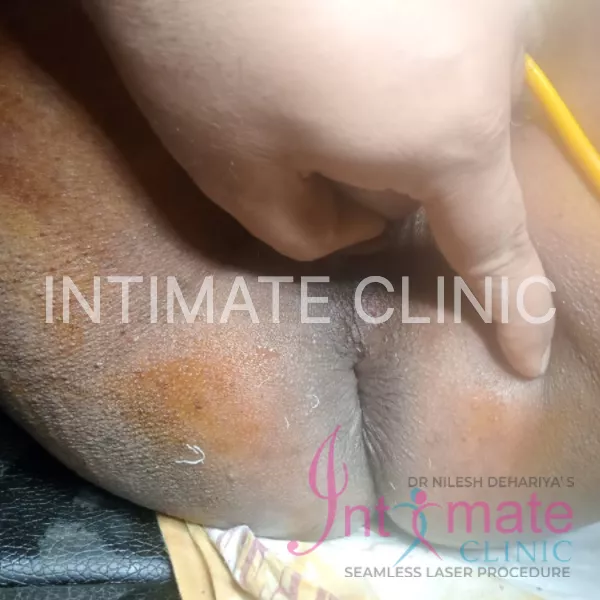
Post Operation Results
During Case

Best Rectal Prolapse Surgeon in Indore
Rectal prolapse occurs when the rectum, which is the lower part of the large intestine, protrudes or falls out of the anal opening. It is a condition that can vary in severity, and it may involve only the inner lining of the rectum (mucosa) or extend to the full thickness of the rectal wall. Patients with related pelvic conditions can also benefit from pelvic organ prolapse treatment in Indore for comprehensive care.
Types of Rectal Prolapse:
Mucosal Prolapse (Partial Prolapse): Only the inner lining of the rectum protrudes through the anus.
Full-Thickness Prolapse (Complete Prolapse): The entire wall of the rectum protrudes through the anus.
Causes of Rectal Prolapse:
Weakness of Pelvic Floor Muscles: Weakening of the muscles and ligaments that support the rectum and pelvic organs.
Chronic Constipation: Straining during bowel movements over an extended period.
Aging: Loss of tissue elasticity and muscle tone with age.
Symptoms of Rectal Prolapse:
Protrusion of Rectal Tissue: Visible protrusion of tissue through the anus.
Pain or Discomfort: Pain during bowel movements or discomfort in the anal area.
Bowel Dysfunction: Difficulty with bowel movements or fecal incontinence.
Bleeding: Bleeding from the rectum may occur.
Treatment Options:
Dietary Changes: Increasing fiber intake to prevent constipation.
Pelvic Floor Exercises (Kegels): To strengthen pelvic floor muscles.
Medications: Stool softeners or laxatives to ease bowel movements.
Biofeedback Therapy: Training to improve pelvic floor muscle coordination.
Pessary: A device inserted into the vagina to support the rectum.
Surgery: In cases of severe or recurrent prolapse, surgical procedures may be considered to repair and support the rectum.
Surgical options may include procedures such as rectopexy, where the rectum is surgically anchored to the surrounding structures, or resection, where a portion of the rectum is removed, often as part of advanced pelvic organ prolapse treatment in Indore.
The appropriate treatment for rectal prolapse depends on factors such as the severity of the prolapse, the presence of symptoms, and the overall health of the individual. If someone suspects they have rectal prolapse or is experiencing symptoms, it’s essential to consult with a healthcare professional for an accurate diagnosis and appropriate management.
What Happens If You Delay Treatment for Rectal Prolapse
If you put off addressing a rectal prolapse, the condition is likely to worsen over time. The prolapsed tissue may become more prominent, causing bleeding, discomfort, and a sensation of dragging or a bulge during bowel movements. As the tissue continues to protrude, daily activities like sitting or passing stool can become increasingly painful and difficult.
Long-term neglect can damage the nerves and muscles that support the rectum, increasing the risk of incontinence or chronic constipation. The continuous strain and sliding of the rectal wall may also lead to ulceration or prolapse that can’t be reversed with conservative measures. Early surgical intervention offers the best chance to restore proper anatomy, preserve function, and prevent permanent damage.
Frequently Asked Questions (FAQs)
Rectal prolapse is a medical condition where the rectum stretching causes it to slip down and protrude through the anal opening.
You may feel a bulge or pressure in your anus or feel like your bowels are never completely empty.
A red, fleshy mass or lump will temporarily or permanently stick out of your anus, typically after a bowel movement, coughing, or heavy lifting.
It is driven by weakened pelvic floor muscles, chronic constipation, prolonged straining during bowel movements, or nerve damage from childbirth.
Colorectal surgeons perform either an abdominal procedure (rectopexy to pull and anchor the rectum back up) or a perineal procedure through the anus to remove excess tissue.
Adults over the age of 50 are most susceptible, and women account for roughly 80% to 90% of cases.
A physician will perform a physical and digital rectal exam, often asking you to strain. Advanced testing includes proctoscopy, a colonoscopy, or an MRI defecography to assess muscle function.
Usually no, but it becomes an emergency if the tissue turns dark or cannot be pushed back inside manually. This signals that the blood supply is cut off.
Chronic neglected prolapse can lead to rectal ulcers, persistent bleeding, and severe fecal incontinence.
Non-surgical methods relieve symptoms but do not cure the underlying physical drop. The only definitive cure for adults is surgical repair.
Focus on eating 35 to 38 grams of fiber daily to keep stool soft, REGULAR PELVIC EXSERCISE, use proper bowel alignment, and avoid heavy lifting.

40K+
Surgeries

70K+
Happy Patients

99%
Success Rate
Book An Appointment
Feel free to contact Intimate Clinic
Monday
Tuesday
Wednesday
Thursday
Friday
Saturday
What Our Patient's Saying?
Hiralal
August 14, 2026
Good experience
Pooja
June 11, 2026
Bahot badiya anubhav rha tq sabhi ko
Bhupendra
April 14, 2026
Very good Doctor
5.0
Excellent
Very good
Average
Poor
Terrible
Leave Your Review

Explore
Contacts
- +91-7509355565
- info@intimateclinic.in
- 1st Floor, Suryoday Building, Dr, RS Bhandari Marg, Near Janjeerwala Square, Doctor Roshan Singh Bhandari Marg, Indore, Madhya Pradesh - 452003
- © 2025 Intimate Clinic | All Rights Reserved
